
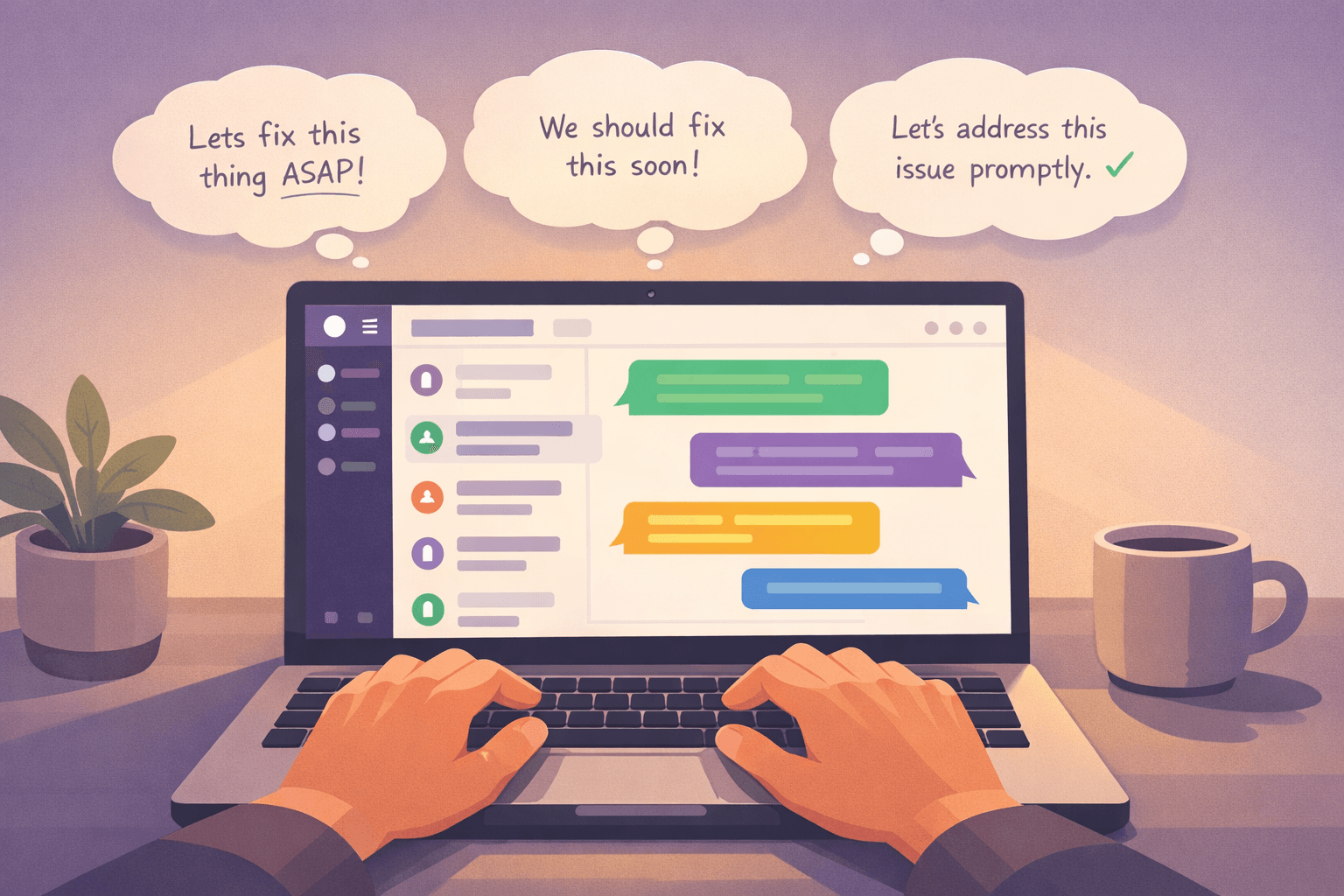
如果你曾经盯着一条 Slack 消息看了五分钟,反复琢磨它听起来是否"得体",那你并不孤单。对于数百万以英语为第二语言的远程工作者来说,异步沟通是工作中最困难的部分之一——不是因为工作本身有多难,而是因为用一门非母语写作,会在每次交流中增加一层无形的阻力。
在视频会议上,你可以微笑、点头,用语气来弥补不足。但在 Slack 里,你只有文字。而这些文字必须同时承载你的专业性、个性和意图。
以下是一些实用建议。
为什么异步沟通比看起来更难
当你进行异步沟通时,你的消息必须独立完成表达。没有肢体语言,没有即时反馈,也没有实时澄清的机会。对于非母语者来说,这带来了一系列独特的挑战:
- 语气是看不见的。 一条在你脑海中听起来完全正常的消息,在英语中可能给人生硬或冷淡的感觉。
- 正式程度很难拿捏。 不同文化对职场沟通有不同的规范。在一种语言中礼貌的表达,在英语里可能显得生硬或疏远。
- 没有"撤回"。 一旦你点了发送,所有人都能看到这条消息并自行解读。
好消息是:你不需要完美的英语也能做到专业沟通。你只需要掌握一些策略。
常见错误(以及如何改正)
过于正式
许多非母语者习惯使用过于正式的语言,因为这样感觉更"安全"。但在大多数远程团队中,尤其是初创公司和科技公司,这样做反而会拉开距离。
过于正式: "Dear Mr. Johnson, I would like to respectfully request your feedback on the attached document at your earliest convenience."
恰到好处: "Hey Mike, could you take a look at this doc when you get a chance? Would love your feedback."
关键是匹配你团队的沟通风格。留意同事们的写作方式,并模仿他们的正式程度。
过于直接
在很多语言中,直接表达是被推崇的。但在英语职场文化中,尤其是书面表达,过于直接的消息可能显得生硬。
过于直接: "This is wrong. Fix it."
更好的方式: "I noticed something off in this section — could we take another look at it together?"
加入一些缓和词,如 "I think"、"maybe"、"could we" 或 "it seems like",效果会好很多。
语气不明确
在没有表情符号或上下文的情况下,中性的消息往往会被解读为负面。这对母语者也是如此,但当你用第二语言写作时,这个问题会被放大。
模糊不清: "OK."
更清晰: "Sounds good, thanks!"
拿不准的时候,宁可偏向温暖一些。
常见场景的实用模板
向团队问好
- "Morning everyone! Hope you all had a good weekend."
- "Hey team, quick update on [project]..."
汇报进展
- "Just wrapped up the designs for [feature]. Sharing the link here — let me know if anything stands out."
- "Still working through the API integration. Should have it ready by end of day tomorrow."
寻求帮助
- "Hey [name], I'm stuck on [specific thing]. Have you dealt with this before? Would appreciate any pointers."
- "Quick question — does anyone know if [specific thing]? I checked the docs but couldn't find it."
礼貌地表达不同意见
- "Interesting idea! I see it a bit differently — what if we tried [alternative] instead?"
- "I hear you on that. One concern I have is [reason]. What do you think?"
跟进
- "Hey [name], just circling back on this — any updates?"
- "Wanted to check in on [topic]. No rush, just want to make sure it's on the radar."
小习惯,大改变
善用话题串。 它们能让对话保持有条理,也显示出你对他人注意力的尊重。
发送前大声朗读你的消息。 如果听起来像机器人或者冷冰冰的,加一句问候或友好的结尾。